
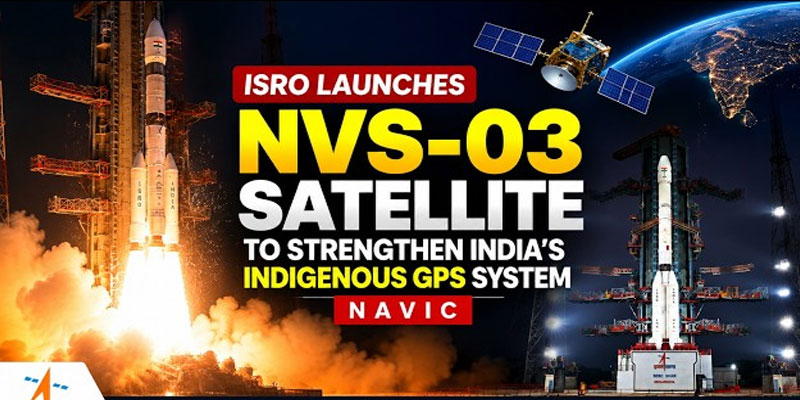
ISRO’s GSLV-F18 mission has successfully launched the NVS-03 navigation satellite, marking another significant milestone in India's efforts to strengthen its independent satellite navigation capabilities. Prime Minister Narendra Modi congratulated ISRO scientists and engineers on the successful launch, describing it as an important achievement for the country's space programme. The mission reinforces India's commitment to developing a reliable, indigenous navigation system with strategic, civilian and technological applications.
A Successful Mission from Sriharikota
The GSLV-F18 rocket lifted off at 11:51 p.m. IST on October 30, 2026, from the Second Launch Pad at the Satish Dhawan Space Centre, Sriharikota. After approximately 18 minutes of flight, the vehicle successfully injected the 2,232-kg NVS-03 satellite into its intended Geosynchronous Transfer Orbit (GTO).
However, reaching GTO is not the final stage. NVS-03 will use its onboard propulsion system to raise its orbit and reach Geostationary Earth Orbit (GEO), where it will appear stationary relative to Earth.
Why NVS-03 Is Important for NavIC
NVS-03 is the third satellite in ISRO's next-generation navigation satellite series. It is designed to strengthen the Indian Regional Navigation Satellite System (IRNSS), popularly known as NavIC.
Its major technological improvements include:
· Advanced atomic clocks: The satellite carries indigenous as well as procured atomic clocks, essential for accurate positioning, navigation and timing (PNT).
· Additional L1 frequency: Alongside the existing L5 and S-band signals, NVS-03 introduces the L1 frequency, improving compatibility with civilian navigation receivers, including many smartphones.
· Extended regional coverage: NavIC provides services across India and approximately 1,500 km beyond its borders.
These capabilities support road, rail and maritime navigation, aviation-related applications, disaster management, surveying and precision timing.
GSLV’s Growing Role in India’s Space Ambitions
The mission is significant beyond the successful deployment of a navigation satellite. GSLV-F18 was the twentieth GSLV flight overall and the fourteenth flight of its Mark II configuration. Twelve Mark II missions had reportedly succeeded before this launch.
The successful injection further demonstrates ISRO's growing confidence in its heavy-lift launch capabilities. The cryogenic upper stage, which operates under extremely demanding conditions, is particularly important for placing heavier satellites into high-energy orbits.
This capability reduces India's dependence on foreign launch providers and strengthens its ability to deploy critical civilian and strategic space infrastructure independently.
What Happens After the Launch?
· Orbital raising: Its onboard propulsion system will gradually move it towards GEO.
· Satellite checkout: ISRO will examine its onboard systems and overall health.
· Navigation validation: atomic clock performance and navigation signals will be tested.
· Constellation integration: Once commissioned, it will strengthen NavIC's operational capacity and redundancy.
A Strategic Leap Towards Navigation Sovereignty
The successful GSLV-F18 mission represents more than another achievement in India's space calendar. Satellite navigation has become critical infrastructure, influencing national security, transportation, disaster response, telecommunications and financial systems that depend on precise timing.
By strengthening NavIC with next-generation satellites, India is building a dependable regional alternative to foreign navigation systems such as America's GPS. NVS-03's additional L1 signal also offers the potential to expand civilian adoption.
Ultimately, the mission reflects India's growing technological maturity and determination to secure strategic autonomy in space. Its successful commissioning will be the next crucial milestone in ensuring that NavIC remains reliable, resilient and increasingly useful for millions of users.
(With agency inputs)