
A Political Pitch Framed as “New Hope”
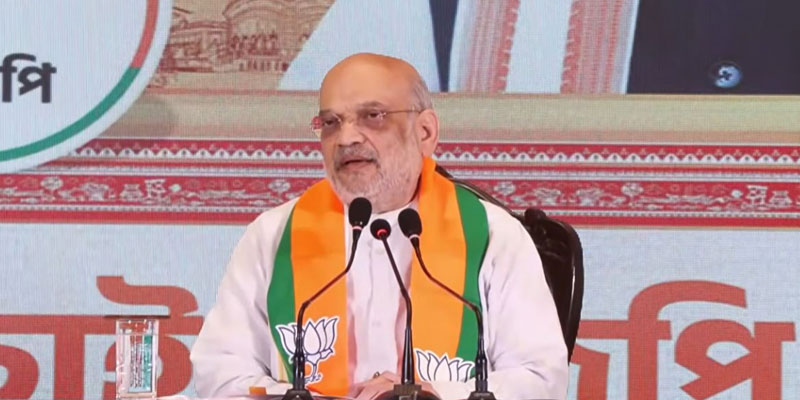
Union Home Minister Amit Shah unveiled the BJP’s ‘Sankalp Patra’ for the 2026 West Bengal Assembly elections in Kolkata, projecting it as a “new hope” for women, youth, and farmers. Positioned against what the BJP terms the “terror” rule of Chief Minister Mamata Banerjee, the manifesto outlines an ambitious roadmap for governance across the state’s 294 constituencies, invoking cultural symbolism and promising swift implementation of reforms.
Key Promises: Welfare and Reform in Focus
At the heart of the manifesto lies a mix of welfare expansion and structural reforms. A major highlight is the promise to implement the Uniform Civil Code (UCC) within six months of forming the government, signaling a strong ideological push.
Women-centric schemes receive significant attention. The BJP has proposed ₹3,000 monthly assistance under an expanded “Lakshmir Bhandar”-style scheme, along with free bus travel and stricter enforcement of laws such as the ban on triple talaq. For youth, the manifesto promises ₹3,000 monthly stipends for unemployed graduates up to 25 years of age, along with the creation of 10 lakh jobs through industrial hubs and skill development initiatives.
Farmers are also targeted with direct income support of ₹20,000 annually, crop insurance coverage, and a legal guarantee for minimum support prices (MSP). Additionally, the implementation of the 7th Pay Commission within 45 days for state employees aims to appeal to a significant voting bloc.
Law, Order and Governance Narrative
A strong emphasis is placed on restoring law and order. The BJP promises action against illegal infiltration, along with the implementation of NRC and CAA provisions—issues that have long shaped political discourse in the state.
Plans include setting up 500 new police stations, fast-track courts for crimes against women and marginalized communities, and eliminating the alleged “cut-money” culture. Healthcare and infrastructure also feature prominently, with commitments to build 50 new medical colleges and provide free treatment up to ₹5 lakh annually.
Economic and Cultural Agenda
The manifesto outlines an ambitious development vision under the banner of “Bikoshito Paschim Banga” (Developed Bengal). Proposed projects include 10 greenfield airports, expansion of railway connectivity through Vande Bharat trains, and major road infrastructure like the Ganga expressway extension.
In education, the BJP promises premier institutions such as IITs and IIMs, along with free coaching for competitive exams. Cultural elements are also woven into the narrative, with assurances of unrestricted Ram Navami celebrations and promotion of Rabindranath Tagore’s legacy.
Strategic Analysis: Targeting Key Voter Segments
The ‘Sankalp Patra’ appears carefully calibrated to counter the Trinamool Congress (TMC) on multiple fronts. By enhancing cash transfer schemes, the BJP seeks to outbid existing welfare programs. Simultaneously, ideological issues like UCC and NRC aim to consolidate support in key constituencies.
Youth unemployment and agrarian distress—two pressing concerns—are addressed through targeted promises, while strict timelines project decisiveness. The manifesto also reflects a blend of populism and development messaging, backed by the broader appeal of “Modi ki Guarantee.”
Electoral Calculus: A Tight Contest Ahead
With projections indicating a close contest between BJP and TMC, the manifesto is designed to energize the party’s base and expand its reach. However, critics question the feasibility of such expansive promises given West Bengal’s high debt levels.
The success of this strategy will depend not only on voter perception but also on the BJP’s ability to translate promises into credible governance narratives.
Ambition Meets Reality
The BJP’s ‘Sankalp Patra’ for West Bengal reflects a high-stakes political gamble—combining welfare expansion, ideological commitments, and infrastructure promises into a single vision. While it aims to reshape the electoral landscape, its impact will ultimately hinge on credibility and execution.
As the state heads toward a crucial election, the manifesto sets the stage for a contest defined by competing visions of governance, development, and identity.
(With agency inputs)