
Kerala’s Distinctive Political Culture
Kerala’s politics has always stood apart from much of India because of its highly aware electorate, strong ideological traditions and deeply rooted coalition structures. For decades, power has alternated almost rhythmically between the Congress-led United Democratic Front (UDF) and the CPI(M)-led Left Democratic Front (LDF), creating one of the country’s most stable bipolar political systems. Unlike many states where caste arithmetic alone dominates elections, Kerala’s politics is shaped equally by ideology, welfare delivery, minority representation and governance credibility.
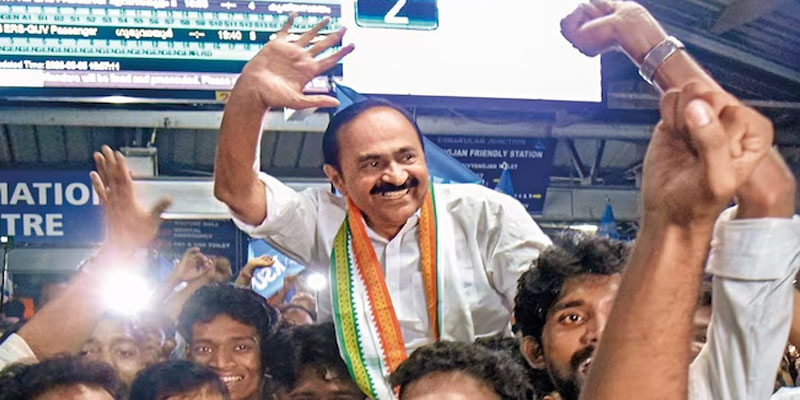
The 2026 Assembly election, however, marked a decisive political moment. After ten years of Left rule under Pinarayi Vijayan, voters handed the UDF a commanding mandate with 102 seats in the 140-member Assembly. The result not only revived Congress dominance in the state but also elevated V. D. Satheesan as the new face of Kerala’s political future.
The Long Political Journey of VD Satheesan
Satheesan’s rise has been gradual rather than dramatic. A legislator from Paravur since 2001, he spent years navigating Congress factionalism without enjoying the rapid elevation often associated with high-profile leaders. Despite his organisational ability and sharp legislative interventions, he was repeatedly overlooked for major positions, including ministerial responsibilities and the Kerala Pradesh Congress Committee presidency.
His turning point came in 2021, when the Congress leadership unexpectedly appointed him Leader of the Opposition. The decision bypassed several senior leaders and reflected the party’s search for a younger, relatively untainted and more energetic public face. Satheesan then built a reputation as an aggressive opposition leader who combined data-driven political strategy with sharp attacks on corruption and communal polarisation.
Even after the UDF’s sweeping victory in 2026, his elevation was not automatic. A tense internal contest with K. C. Venugopal revealed the continuing influence of Congress high-command politics and factional balancing in Kerala. Eventually, Satheesan emerged successful, supported by both grassroots sentiment and central leadership confidence.
Why Remaining a Popular Chief Minister Is Difficult
Kerala is perhaps one of the toughest states in India for any chief minister seeking sustained popularity. The electorate is politically conscious, socially vocal and highly demanding. Governments are judged not merely on slogans but on measurable improvements in employment, infrastructure, healthcare, education and welfare delivery.
Satheesan inherits both opportunity and pressure. His cabinet, which includes leaders such as Ramesh Chennithala and K. Muraleedharan alongside influential IUML figures, reflects the coalition’s broad social composition. Yet managing such diversity can also become politically exhausting.
The larger challenge lies in balancing Kerala’s expansive welfare commitments with fiscal realities while preventing corruption allegations and factional disputes from weakening public trust. In Kerala, charisma alone rarely sustains political success; administrative performance does.
Governance, Expectations and the Real Test Ahead
VD Satheesan’s ascent symbolises both generational change within the Congress and Kerala’s continuing faith in democratic alternation. His victory represents public fatigue with prolonged incumbency, but it also creates enormous expectations. If his government can combine transparency, economic growth and welfare stability while maintaining coalition unity, Satheesan could redefine Congress leadership in Kerala. If not, Kerala’s politically vigilant electorate may once again prove how swiftly it can reward — and remove — those in power.
(With agency inputs)