
India and the United States are currently engaged in advanced discussions aimed at jointly manufacturing the latest generation of Stryker Armoured Infantry Combat Vehicles (ICVs). This initiative forms a crucial part of a broader defence-industrial cooperation roadmap between the two nations, signaling a significant step towards enhancing India's defence capabilities.
Project Overview:
The proposed project involves a phased implementation such as Initial procurement of Strykers through the US Foreign Military Sales (FMS) program and Transition to joint production in India. Co-development of advanced variants tailored to Indian Army specifications.
Operational Imperatives: With the Indian Army seeking to modernize its mechanized infantry capabilities, the Stryker is being evaluated as a potential replacement for the aging fleet of over 2,000 Russian BMP-II vehicles. The project emphasizes a high level of indigenisation, including the transfer of critical technologies to Indian partners, potentially involving Defence Public Sector Undertakings (PSUs) or private firms.
Strategic Significance and Diplomatic Efforts:
- Strategic Partnership: The US has actively promoted the Stryker as a cornerstone of bilateral defence ties, underscoring its commitment to strengthening defence partnerships with India.
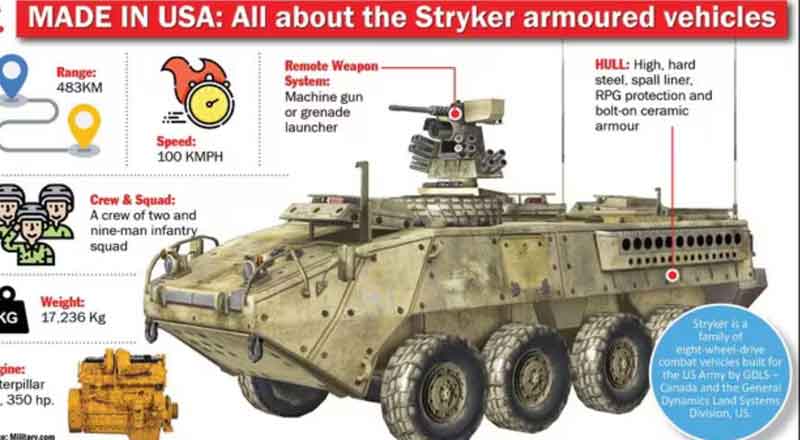
- Technological Advantages: Developed jointly by General Dynamics Land Systems (GDLS) Canada and the US, the Stryker is renowned for its versatility, mobility, and firepower, making it suitable for diverse operational environments.
- Adaptability: Available in multiple variants including Infantry Carrier Vehicles (ICVs) and Mobile Gun Systems (MGS), the Stryker is equipped with a 30 mm cannon and a 105 mm mobile gun, enhancing its effectiveness in urban warfare and rapid response scenarios.
- Protection Features: Incorporating V-hull design and advanced ceramic armour, the Stryker offers robust protection against ballistic threats and explosives, thereby enhancing crew survivability.
- Mobility and Deployment: Powered by a Caterpillar C7 engine, the Stryker achieves speeds up to 100 km/h with a range of 483 kilometers. Its compatibility with Indian Air Force Chinook helicopters facilitates rapid deployment and operational flexibility across varied terrains.
- Combat Proven: Deployed in conflict zones such as Afghanistan and Ukraine, the Stryker has demonstrated operational effectiveness against insurgent forces and in asymmetric warfare scenarios, highlighting its reliability and combat readiness.
- Tactical Advantage: The Stryker's capability to swiftly deploy and engage in urban and rural settings provides a critical edge in responding to evolving security challenges and bolstering India's defensive posture.
- Support for ‘Atmanirbhar Bharat’: Collaboration with the US underpins India's efforts to strengthen its indigenous defence manufacturing capabilities, leveraging Transfer of Technology (ToT) agreements to integrate advanced systems into domestic production lines.
- Strategic Autonomy: Joint production and technology infusion from the US not only enhance operational capabilities but also contribute to India's strategic autonomy in defence procurement and industry development.