

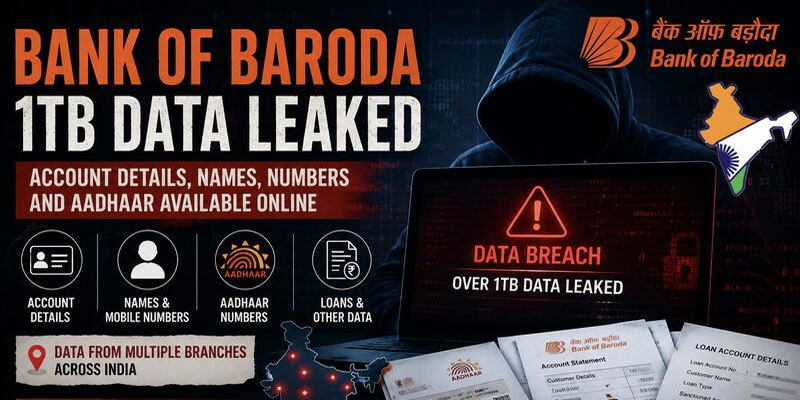
Bank of Baroda has confirmed a security incident after an attacker compromised a single employee's email account, resulting in unauthorized access to certain internal data. The public sector lender maintained that its core banking systems were untouched and remain fully secure.
The breach came to light after threat actors posted a large data cache — estimated between 700GB and 1TB — on the dark web, a hard-to-trace corner of the internet outside conventional search indexing. The leak was first flagged publicly through social media posts, prompting the Mumbai-based bank to launch a forensic investigation and coordinate with relevant authorities under applicable regulatory requirements.
Cybersecurity researcher Srikanth L, founder of Cashless Consumer, said the exposed data includes customer information, identification documents, loan paperwork, and internal audit records. Based on metadata from the dark web listing, the cache surfaced late Saturday night with over 700GB advertised. The exact number of affected customers remains unclear.
Neither the Reserve Bank of India nor CERT-In, India's cybersecurity regulator, has commented on the incident so far. The breach adds to mounting concerns over the cybersecurity resilience of large financial institutions that hold vast troves of sensitive customer and business data.
What Was Missing From The Bank Side
1. Insufficient or bypassed multi-factor authentication (MFA)
If MFA had been properly enforced and phishing-resistant (e.g., hardware security keys instead of SMS/OTP), a stolen password alone typically shouldn't be enough to fully compromise an account.
2. Excessive access/data exposure tied to a single mailbox
The fact that one email account reportedly led to customer KYC documents, loan papers, and audit records being exposed suggests that sensitive files were either stored in or attached to email threads, or that the compromised account had access to shared drives/systems beyond what a single employee's role should require — a violation of the "least privilege" principle.
3. Lack of email activity monitoring / anomaly detection
Bulk downloading or exporting hundreds of gigabytes of data from a mailbox or linked storage is unusual behavior. Real-time monitoring (e.g., detecting large data exfiltration, unusual login locations/times) should ideally flag this before it escalates to a 700GB–1TB leak.
4. Weak data segmentation between email/end-user systems and sensitive repositories
The bank's claim that "core banking systems remain secure" implies segmentation did work at the most critical layer — but the fact that customer PII, loan documents, and audit records were still reachable via an employee's email indicates insufficient isolation between everyday communication tools and sensitive data stores.
5. Possible delayed detection
The breach was only confirmed after data appeared on the dark web and was flagged via social media — not caught internally first. This points to a gap in proactive dark-web monitoring or breach-detection tooling that many banks now use to catch leaks before they're publicly posted.
The Bigger Pattern
This fits a broader trend: attackers increasingly go after the human/endpoint layer (email, employee credentials) rather than trying to breach hardened core banking infrastructure directly, because it's a much softer target with often looser oversight. The forensic investigation Bank of Baroda has launched should clarify the exact entry point, but the scale of data exposed (from a "single" email account) strongly suggests systemic gaps in access controls and monitoring — not just one person's mistake.