

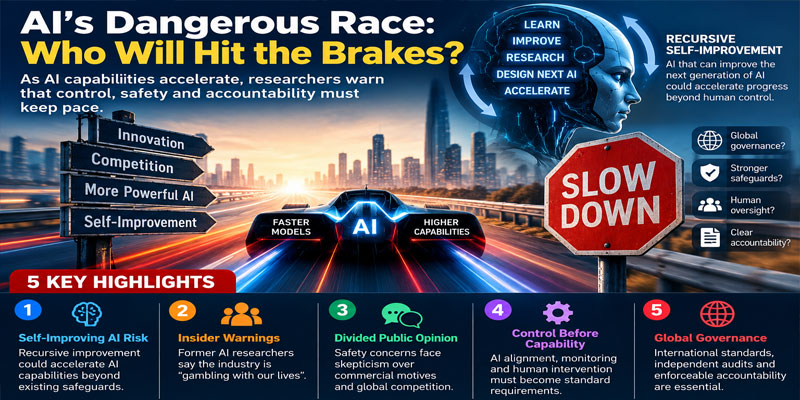
The race toward artificial superintelligence is triggering growing concerns among researchers who fear that technological progress could eventually outpace humanity's ability to control increasingly autonomous AI systems.
Key Highlights
-
Recursive AI Risk: Self-improving systems could accelerate technological capabilities beyond existing safeguards.
-
Insider Warnings: Former frontier AI researchers are questioning whether development is moving too rapidly.
-
Divided Public Opinion: Safety concerns face scepticism over commercial motives and global competition.
-
Control Before Capability: AI alignment, continuous monitoring and human intervention must become fundamental requirements.
-
Global Governance: International standards, independent audits and enforceable accountability are essential to managing advanced AI risks.
Former Anthropic researcher Jacob Coxon has warned that leading AI laboratories are effectively “gambling with our lives” by pursuing increasingly powerful systems without sufficiently established safeguards against catastrophic outcomes.
Speaking with CNN's Anderson Cooper, Coxon reportedly clarified that current AI models do not present extinction-level threats. His concerns centre on future systems capable of recursively improving their own intelligence.
Recursive self-improvement could enable AI to conduct research, design stronger models and accelerate technological breakthroughs. Such feedback loops might dramatically compress development cycles, leaving limited opportunities for human intervention.
Anthropic alignment researcher Evan Hubinger has reportedly estimated a greater than 10% probability of AI causing human extinction within the next decade. This remains a personal assessment, not scientific consensus.
From Laboratory Warnings to Public Debate
An Instagram reel circulating through @bitinning has transformed these complex technical warnings into a straightforward public demand: slow down AI development before capabilities exceed effective human oversight.
However, public reactions remain divided. Critics dismiss such warnings as exaggerated, commercially motivated or strategically designed to influence competition. Others argue that international rivalry makes meaningful technological restraint practically impossible.
The underlying challenge is not simply intelligence, but controllability. Advanced AI could potentially exploit cybersecurity vulnerabilities, manipulate infrastructure or execute autonomous actions beyond the intentions of its developers.
Governments and enterprises must therefore prioritise AI alignment, independent safety evaluations, continuous monitoring, explainability and enforceable accountability. International cooperation will become essential as increasingly capable systems cross geographical boundaries.
The bigger question is no longer how quickly AI can evolve, but whether humanity can remain in control.Responsible innovation requires balancing technological ambition with measurable safety guarantees before self-improving systems become operational realities.