

A Humanitarian Response at a Critical Moment
India’s decision to offer DNA profiling support to families of people missing in Nepal’s devastating floods is more than a forensic initiative. It addresses one of the most painful challenges after a catastrophe: identifying victims whose remains are damaged beyond visual recognition and helping families finally know what happened to their loved ones.
A Disaster That Has Left Thousands Unaccounted For
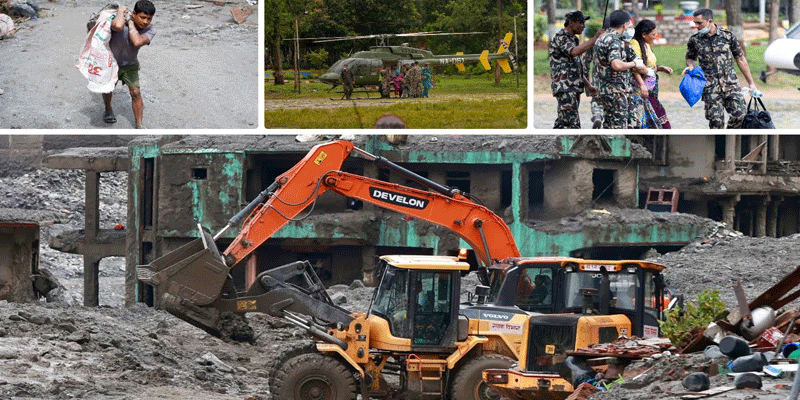
The August 26 ice-and-rock avalanche near the Nepal-Tibet border unleashed catastrophic flash floods across the Bhotekoshi and adjoining river valleys. Villages, roads, bridges and hydropower infrastructure were swept away, while the scale of destruction severely complicated rescue and identification efforts. By September 4, Nepal’s reported death toll had crossed 1,250, while more than 5,000 people remained missing.
The recovery of bodies has created another grim challenge. Many remains are mutilated, fragmented or decomposed after prolonged exposure to water and debris, making conventional identification through faces, fingerprints or personal belongings extremely difficult. DNA therefore becomes crucial for establishing identities with scientific certainty.
India Opens Its Forensic Network to Families
Under the latest assistance announced by the Ministry of External Affairs, first-degree biological relatives of missing persons living in India can have their DNA profiles prepared for comparison with unidentified remains in Nepal. The eligible relatives include fathers, mothers, sons, daughters and siblings.
Samples can be processed through Central Forensic Science Laboratories, State Forensic Science Laboratories, National Forensic Sciences University facilities and NABL-accredited laboratories capable of DNA profiling. The profiling is to follow the Autosomal STR method recommended by Nepal Police, allowing results to be compared with DNA obtained from recovered remains.
This creates a direct scientific bridge between grieving families in India and forensic teams working in Nepal, potentially accelerating identification and repatriation.
Indian Experts Already Working in Kathmandu
India’s support is not limited to laboratory access. A 19-member Indian forensic team has already begun working alongside Nepali specialists at the Nepal Police Central Forensic Science Laboratory and the National Forensic Science Laboratory in Kathmandu. The team is helping process DNA samples and accelerate victim identification.
The assistance complements India’s wider disaster-response effort, which includes specialised rescue personnel working with Nepali authorities at hydropower facilities. Two trapped workers were also rescued alive from a hydropower tunnel on September 4, highlighting the continuing complexity of the operation.
Beyond Forensics, a Message of Regional Solidarity
The DNA initiative carries significance beyond technology. Nepal’s disaster has demonstrated how quickly Himalayan emergencies can overwhelm conventional rescue, communication and identification systems. With foreign nationals among the missing, cross-border forensic cooperation has become an essential part of the humanitarian response.
For India, opening its forensic infrastructure provides practical assistance to affected families while reinforcing longstanding ties with Nepal. It also demonstrates how specialised scientific capabilities can become instruments of humanitarian diplomacy.
Science Brings Identity, Dignity and Closure
In a disaster where water and debris have erased physical identities, DNA can restore something profoundly important: certainty. India’s intervention cannot undo the tragedy, but it can help return victims to their families with dignity and give thousands waiting for answers a path toward closure. At a time when Himalayan disasters are becoming increasingly destructive, such cooperation shows that regional resilience will depend not only on rescue teams and relief supplies, but also on science, shared expertise and human solidarity.
(With agency inputs)