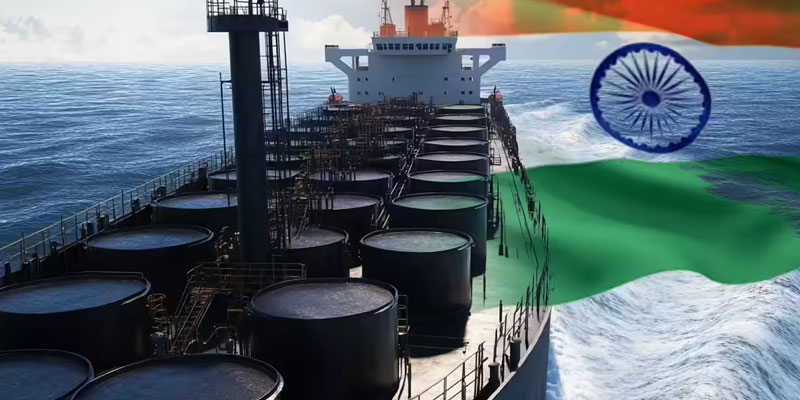
The Adani Group’s decision to ban sanctioned vessels from docking at its ports could reshape India’s crude oil import dynamics, particularly its heavy reliance on Russian supplies. Adani Ports and Special Economic Zone (APSEZ), India’s largest private port operator, announced it will no longer allow ships sanctioned by the U.S. Office of Foreign Assets Control (OFAC), the European Union, and the UK to access its facilities.
The move covers Mundra Port in Gujarat, a crucial hub that alone handles nearly 10% of India’s crude imports. Mundra is especially significant for Russian oil flows, as over half of its crude arrivals in recent years have come from Russia. With India sourcing more than one-third of its total crude oil from Russia, the restrictions could pose a major challenge.
APSEZ operates 15 domestic ports and terminals, commanding a 27.8% market share with strong footprints across India’s west, south, and east coasts. Mundra stands out for its advanced infrastructure, including two single-point moorings capable of handling Very Large and Ultra Large Crude Carriers, supplying key North Indian refineries such as HPCL-Mittal Energy (HMEL) and state-run Indian Oil.
According to real-time analytics firm Kpler, the decision is widely seen as a response to international pressure. Sumit Ritolia, Kpler’s Lead Research Analyst for Refining & Modeling, highlighted that Mundra has consistently received around 400,000 barrels per day of crude oil, with Russian shipments making up the bulk.
Given Adani’s scale, the ban represents a “major development in the global oil market” and could significantly disrupt Russia’s crude exports to India. The outcome may also test India’s ability to balance its growing energy needs with geopolitical sensitivities amid tightening Western sanctions.